Les résidus de culture
Importance des résidus de culture
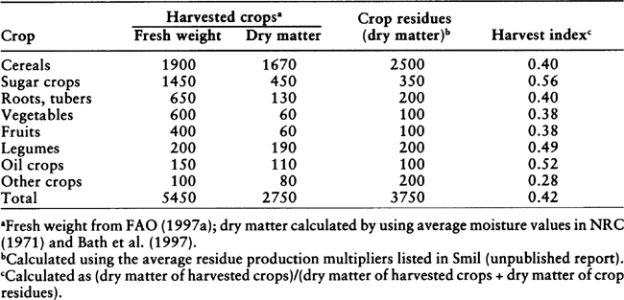
Cultures | Volume récolté | Résidus | Indice de récolte | |
|---|---|---|---|---|
Poids frais | Matière sèche | Matière sèche | ||
Céréales | 1900 | 1670 | 2500 | 0,40 |
Plantes sucrières | 1450 | 450 | 350 | 0,56 |
Racines, tubercules | 650 | 130 | 200 | 0,40 |
Légumes | 600 | 60 | 100 | 0,38 |
Fruits | 400 | 60 | 100 | 0,38 |
Légumineuses | 200 | 190 | 200 | 0,49 |
Oléagineux | 150 | 110 | 100 | 0,52 |
Autres cultures | 100 | 80 | 200 | 0,28 |
Total | 5450 | 2750 | 3750 | 0,42 |
L'importance des résidus de culture est considérable si on la compare aux volumes récoltés pour la production d'aliments pour l'homme et le bétail, ou de fibres. Cependant il n'existe aucune statistique officielle sur le volume de résidus produits par pays ou mondialement, mais seulement des évaluations issues d'études concernant la gestion des agroécosystèmes, l'énergie potentielle de la biomasse, l'alimentation animale, ou les émissions de gaz à effet de serre. Une évaluation, basée sur la notion d'indice de récolte, chiffre à 3,75 milliards de tonnes de matière sèche le volume mondial de résidus dans les années 1990, pour un indice de récolte moyen de 0,421, ce qui signifie que les résidus de culture représentent en moyenne 58 % de la phytomasse produite par les cultures.
Vaclav Smil, Crop Residues: Agriculture's Largest Harvest: Crop residues incorporate more than half of the world's agricultural phytomass, BioScience, Volume 49, Issue 4, April 1999, Pages 299–308, https://doi.org/10.2307/1313613
Intérêts
Les scientifiques — notamment les agronomes et les pédologues — qualifient de «litière» les résidus restés au sol l’hiver. Laisser la litière en place pendant l’hiver plutôt que de la retirer ou de l’enfouir dans le sol offre de nombreux avantages pour le sol et pour le jardin.
Les résidus végétaux réduisent l’érosion et la perte de la si importante «couche arable». La litière recouvre le sol et le protège après que la saison de croissance des plantes soit terminée. Les résidus de récolte attrapent les précipitations et réduisent ainsi la force d’impact des gouttelettes de pluie individuelles sur la surface du sol. La litière ralentit également l’écoulement de l’eau de la fonte des neiges, lui permettant de pénétrer le sol. Tout cela aide à protéger la structure du sol, la gardant intacte pour les cultures de l’année suivante.
Lorsqu’il ne reste aucune litière sur le sol, il peut se former une croûte. Cela réduit la capacité naturelle du sol à absorber l’eau de pluie et celle de la fonte des neiges et peut augmenter l’érosion. Source: Kate Norvell
La présence de résidus de plantes à la surface du sol empêche également ce dernier de se croûter. Vous avez peut-être remarqué que, lors de fortes pluies, un sol croûté n’absorbe aucune eau. Pire encore, de petits ruisseaux se forment parfois sur un sol sec pour devenir ensuite de véritables torrents qui emportent le sol et ses nutriments importants.
La matière végétale résiduelle réduit les mauvaises herbes en recouvrant et en ombrageant le sol. Les mauvaises herbes germent souvent au début du printemps et ces résidus inhibent leur croissance. Les résidus de culture limitent aussi la quantité de sol disponible pour la germination et la croissance de ces plantes indésirables et réduisent également les ressources et l’espace nécessaires à la croissance des jeunes plants de mauvaises herbes.
Comparaison des températures du sol par une journée où la température de l’air était de 29,5 °C. Source : Ann Fischer
Les résidus végétaux fournissent de l’ombre et aident à contrôler la température du sol. Ils contribuent à garder les sols plus frais pendant toute la saison morte et jusqu’au début de la saison de croissance suivante. Des températures de sol plus fraîches fournissent des conditions plus appropriées pour le développement des microbes bénéfiques du sol. Ces microbes sont nécessaires au maintien d’un sol productif, ce qui permet un développement maximal des cultures.
Des températures de sol plus fraîches contribuent également à la rétention de l’humidité du sol, ce qui est aussi favorable à la germination des graines au printemps, puis à la croissance des cultures.
Les résidus de culture fournissent des microhabitats qui protègent et favorisent les semences de plantes en germination et l’établissement de jeunes plants.
La litière constitue une source de matière organique pour le sol. Or, la matière organique est essentielle à la santé du sol. Elle aide à créer un environnement favorable à la croissance des cultures. Les matières organiques constituent une source d’énergie pour les populations microbiennes du sol, ce qui accélère les taux de décomposition et libère les nutriments essentiels à la croissance des cultures. La matière organique du sol aide également à maintenir la bonne structure du sol lui-même, ce réduit davantage l’érosion tout en améliorant l’infiltration d’eau et l’aération du sol.
Texte de Kelley House, pédologue agréée (Duraroot) et Kate Norvell, pédologue agréée et agronome professionnelle agréée (North 40 AG, Inc.). Traduction : jardinierparesseux.com
Ensemencement de céréales à travers la litière végétale de la saison précédente: c’est la culture sans labour maintenant recommandée par les agronomes. Le jardinier amateur peut faire la même chose à (beaucoup) plus petite échelle. Source: nrcs.usda.gov
Certes mais pas n'importe comment
https://www.sillonbelge.be/3116/article/2018-09-20/que-faire-des-residus-de-recolte-du-potager
Les spores, le mycélium, les œufs, les larves et de manière générale les formes de survie des maladies et des ravageurs restent au champ avec les résidus de culture. Les laisser en l’état en surface du sol c’est entretenir des foyers d’inoculum pour les cultures voisines et pour l’année suivante.
Des solutions ?
Plusieurs méthodes permettent de limiter l’impact de ces présences. Le broyage et l’enfouissement superficiel sont des classiques, le ramassage et l’élimination peuvent améliorer la situation en cas de risques ponctuels.
Le travail superficiel du sol permet également de réaliser des faux semis et diminuer ainsi le niveau de salissement du terrain et permet de lutter contre les limaces, les tipules et les taupins. L’incorporation superficielle des débris de culture en facilité la décomposition. Notons que le faux semis est efficace si le sol est rappuyé pour permettre un contact franc entre les graines et le sol.
Ce travail superficiel remet le sol à niveau et prépare l’implantation des cultures suivantes. Il permet aussi l’incorporation des composts et fumiers.
À quelle profondeur ?
Nous pouvons donner comme ordre de grandeur 5 cm de profondeur ou un peu moins. À cette profondeur, l’aération du sol peut encore être très forte et favorise une bonne évolution des résidus broyés. Si l’incorporation est moins profonde, l’effet sur la germination des graines sera meilleur.
Les inconvénients ?
Plusieurs inconvénients s’opposent à l’incorporation rapide des résidus de culture à faible profondeur.
Le paillage en matières organiques ou en matières plastique est perturbé ou détruit par les façons culturales superficielles.
Les ados doivent être refaçonnés après le travail superficiel du sol en même temps que celui-ci.
Quels outils ?
Les outils animés à axe horizontal permettent de broyer et d’incorporer superficiellement en un seul passage.
Les disques concaves sont bien adaptés pour les enfouissements de matière organiques.
Un rouleau stabilisateur raffermit le sol après le passage d’enfouissement.
Des exemples
L’exemple du chou
Après une culture de choux, il reste une grande masse végétale, des tiges, collets et plateau d’enracinement massifs et coriaces. Le broyage fin avec un outil animé à axe horizontal (type fraise) va favoriser la dégradation rapide et le mélange superficiel avec la terre. Si la température du sol est suffisante (plus de 12ºC) et l’humidité présente pour avoir une grande activité des organismes présents dans le sol, la décomposition est rapide et est déjà bien avancée après 3 semaines.
Le cas de la laitue
Les tissus sont peu coriaces, en conditions suffisantes d’humidité et de température, une dizaine de jours suffisent pour avoir une bonne dégradation des résidus. Cela ne signifie pas que tout est résolu. Si des foyers de sclérotiniose étaient présents à la récolte, ils resteront présents malgré le broyage et l’incorporation. D’autres méthodes de lutte seront à mettre en place, dont la rotation et l’emploi préventif du Contans WG.
Le cas des infestations de limaces
Le travail superficiel avec broyage des résidus de culture est une excellente méthode pour réduire les populations de limaces à court terme et à plus long terme. En effet, les résidus broyés décomposés sont autant de nourriture que les limaces n’auront plus. Les œufs malmenés et exposés au dessèchement et au soleil perdent leur viabilité. La surface du sol est affinée ce qui réduit la facilité de remontée et de redescente quotidienne des limaces en surface.
En bref
Le broyage des résidus de culture en leur incorporation en surface de sol favorise la dégradation et le recyclage des matières organiques. Cette méthode diminue la viabilité de plusieurs ravageurs et maladies. Elle n’élimine pas les risques de certaines d’entre elles comme les sclerotinioses mais ne les aggrave pas.
F.
Crop Residues: Agriculture's Largest Harvest: Crop residues incorporate more than half of the world's agricultural phytomass Vaclav Smil
JOURNAL ARTICLE BioScience, Volume 49, Issue 4, April 1999, Pages 299–308, https://doi.org/10.2307/1313613Published: 01 April 1999
Plant parts used for food and fiber, and crops grown for animal feed, do not produce most of the phytomass harvested annually by the world's agriculture—crop residues do. More than half of all absolutely dry matter in the global harvest is in cereal and legume straws; in tops, stalks, leaves, and shoots of tuber, oil, sugar, and vegetable crops; and in prunings and litter of fruit and nut trees. Consequently, it would not be inappropriate to define agriculture as an endeavor producing mostly inedible phytomass.
Unfortunately, we cannot either accurately quantify this enormous harvest or satisfactorily account for its fate, which may help to explain why so little attention has been paid to crop residues: The latest US agricultural encyclopedia has no entry for either crop residues or straw (Arntzen 1994), and the only comprehensive interdisciplinary overview of cereal straw was published nearly a generation ago (Staniforth 1979). Nevertheless, there is no doubt that a large part of the residual harvest is handled inappropriately, weakening the world's food-production capacity and contributing to undesirable biospheric change. Such malpractice is particularly common in low-income countries, where inadequate amounts of residues are recycled while unacceptably large amounts of straws and stalks are burned, either in the fields or as household fuel.
In this article, I deal with each of these major concerns. I begin by quantifying the world's crop residue production; next, I review the variety of off-field uses of residues; and finally, I explain the agroecosystem benefits of recycling this phytomass and the negative impacts of burning straws and stalks, a traditional practice that I suggest should give way to better approaches to crop residue management.
Crop residues should be seen not as wastes but as providers of essential environmental services, assuring the perpetuation of productive agroecosystems
Quantifying the harvest
No nation keeps statistics on the production of crop residues. The occasional countrywide or global totals have been calculated only as part of studies that assess the possibilities of better agroecosystem management, of the potential contribution of biomass energies (a concern that was fashionable during 1974 and 1985, when energy prices were high), of resources for animal feeding, or of emissions of greenhouse gases (Owen 1976, USDA 1978, Smil 1983, Kossila 1985, Andreae 1991).
Harvest indices. The most reliable data on residual phytomass come indirectly, from studies of harvest index (HI), which is the ratio of crop yield—be it edible seeds, leaves, stalks, or roots—to the crop's total aboveground phytomass. This ratio has been of great interest to plant breeders because the impressive yield improvements during the twentieth century have resulted overwhelmingly from increases in the proportion of photosynthate channeled into harvested tissues (Donald and Hamblin 1976, Gifford and Evans 1981, Hay 1995).
For example, traditional wheat varieties cultivated at the beginning of the twentieth century were approximately 1 m tall and had HI mostly between 0.25 and 0.35, producing 1.8–3.0 times as much residual phytomass as grain (Singh and Stoskopf 1971). Mexican semidwarf cultivars of the 1960s measured no more than 75 cm, and their HI was approximately 0.35; by the late 1970s, many short-stalked wheat cultivars had HI close to 0.5, producing as much grain as straw (Smil 1987).
Typical HI averages are now 0.40–0.47 for semidwarf wheats and 0.40–0.50 for high-yielding rice. The highest HI for a major crop is 0.60, for sweet potato. The need to produce indispensable structural and photosynthetic tissues puts a clear limit on HI. The most likely maximum HI for cereals is between 0.60 and 0.65 because it would be impossible to support more than 65% of the total yield as grain on less than 35% of the overall phytomass; however, HI values of up to 0.80 may be achieved with some root crops (Hay 1995).
There is no shortage of published harvest indices for major field crops, but the choice of average values for calculating nationwide or global residue production is difficult because the ratios vary, both among major cultivars and for the same cultivar grown in different environments (Figure 1). HI is also determined by agronomic factors. For example, Prihar and Stewart (1991) showed that HI in sorghum may be significantly affected by planting date and irrigation regime. Furthermore, experiments by Roberts et al. (1993) demonstrated that for water-seeded California rice, HI varied more and decreased more rapidly with increasing nitrogen applications in tall cultivars (from a high of 0.58 to 0.37) than in semidwarf varieties (from 0.59 to 0.47).
Figure 1.Open in new tabDownload slide
Harvesting of rice in China. Although modern short-stalked cultivars have much higher harvest index than traditional varieties, they still yield as much straw as grain (commonly 5–7 t/ha).
Residue multipliers. Production of crop residues is most commonly expressed as straw:grain (S:G) ratios. The standard practice is to quote residue production in terms of dry-matter mass and crop yield at field moisture (Smil 1983, unpublished report). The residual mass, expressed as a multiple of harvested yields, can be obtained simply as (1 - HI)/HI. This total will be somewhat larger than the S:G ratio because the latter index may not include stubble.
Whatever ratio is used, variability of environmental and agronomic factors precludes an accurate calculation of global crop residue production. Fluctuations in cereal straw output have a particularly large effect. For example, multiplying the global cereal harvest by an average S:G ratio of 1.3, rather than just 1.2, will add almost 200 Mt more straw, a difference that is larger than the total residual phytomass produced by all tuber and root crops. In my calculations of residue production, I have tried to minimize such errors by calculating residue output separately for approximately 40 different crops, rather than just for major crop categories. I have used the United Nations Food and Agricultural Organization's crop-production figures, together with the best available information on water content of harvested parts, and have selected fairly conservative residue production multipliers.
Global production. These calculations result in an annual output of 3.5–4.0 Gt of crop residues during the mid-1990s; the most likely total, 3.75 Gt, is nearly 1.4 times the size of the annual aggregate crop harvest (Table 1). Cereal stem, leaf, and sheath material accounts for two-thirds of all residual phytomass, and sugar cane tops and leaves are the second-largest contributor. Just over 60% of all residual phytomass is produced in low-income countries, and close to 45% of it originates in the tropics.
Table 1.Open in new tabDownload slide
Annual global harvest of crops and crop residues in the mid-1990s (all figures are x 1061
Any calculated total of residual phytomass would be substantially enlarged by the inclusion of crop processing residues, such as husks and brans (which make up approximately 13% of ripe rice, for example) or sugarcane bagasse (the fibrous residue remaining after the milling of cane stalks, which amounts to 15–18% of the fresh weight of the cane plant). However, these forms of phytomass are readily used as either good-quality feed (in the case of grain milling residues) or as industrial fuel (in the case of bagasse in sugar refining operations) and are rarely, if ever, candidates for field recycling or other forms of disposal.
Residues as resources
Crop residues represent substantial global stores of fiber, energy, and plant nutrients, even when they are compared with the largest commercial sources of these commodities—wood pulp, fossil fuels, and synthetic fertilizers. Residue composition is dominated by cellulose, hemicellu-lose, and lignin (Barreveld 1989). Cellulose—a linear polysaccharide made of 1–4 β-linked glucose units with molecular weights that are usually in the range of 300,000–500,000—generally accounts for 30–50% of residual phytomass but can make up as much as 61% of rice stumps (Mukhopadhyay and Nandi 1979). Hemicellulose—another linear polymer, made up of pentoses—typically makes up 25–30% of dry phytomass. Finally, lignin (tree prunings aside) accounts mostly for 10–20% of dry phytomass.
Assuming that no more than 35% of straw and stalk mass would be extracted as pulp (for wood, the yield is approximately 50%), the world's crop residues contain an equivalent of approximately 1.3 Gtof cellulosic fibers, or approximately eight times as much as is now produced annually from wood. But even if there were no other uses for these residues, they would not become the primary supplier of cellulose: The low density of cereal straws (typically just 50–100 kg/m3, compared to 600–800 kg/m3 for wood), and their scattered and seasonal availability, which result in high field collection and transportation costs, are obvious disadvantages when compared to wood.
The energy content of dry residues averages approximately 18 MJ/kg (or approximately 4300 kcal/kg); hence, their annual output contains some 65 EJ, the equivalent of approximately 1.5 Gt of crude oil. For comparison, annual world consumption of fuelwood and charcoal is now close to 1.0 Gt of oil equivalent, and that of natural gas equals approximately 1.9 Gt of oil equivalent (British Petroleum 1998). Competing uses limit the share of residues harvestable as fuel, and the drawbacks of low density and high collection costs apply for this use as well. But residues have been, and remain, a major local source of household energy in many rural areas; they may provide no more than 5 EJ, or just over 100 Mt of oil equivalent (Smil 1991), but they are very important locally.
Substantial inter- and intraspecific variations in the nutrient content of crop residues allow only approximate calculations of total nitrogen, phosphorus, and potassium incorporated annually. The nitrogen content of various cereal straws ranges between 0.4 and 1.3% (0.6% is typical), and only pulse straws are relatively nitrogen rich. The potassium content of most residues is approximately 1.0–1.25%, an order of magnitude more than the phosphorus content (0.1%). Total nitrogen incorporated into residues now amounts to approximately 25 Mt per year, or one-third of the total amount taken up by crops (Table 2). Crop residues incorporate almost 30% of all phosphorus taken up by crops and approximately 65% of all potassium. Nitrogen and phosphorus incorporated annually into crop residues is equivalent to approximately 30% of each nutrient contained in synthetic fertilizers, and potassium incorporated into crop resides represents approximately twice as much as is available in fertilizer compounds.
Table 2.Open in new tabDownload slide
Annual macronutrient content of crops, crop residues, and inorganic fertilizers (all figures are x 1061)
Variety of uses
Crop residues have always been used in many ways. They have been an important source of household fuel and building material in many low-income countries (Figure 2); provided indispensable bedding and feed for animals, particularly ruminants, of all continents; offered an excellent substrate for cultivation of mushrooms; been used for making paper; and been tapped as sources for extracting organic compounds.
Figure 2.Open in new tabDownload slide
Dried straw, which must be stored outdoors, is often arranged in ways that preserve its quality.
Household fuel. The bulkiness and relatively low energy content of crop residues make them inferior to wood—but they are still an important source of energy in densely populated and arid or deforested regions of Africa and Asia. China's rural energy surveys show that during the late 1980s, roughly three-quarters of the country's crop residues, including more than two-thirds of all cereal straws, were burned in cooking stoves (Smil 1993).
In many countries, expanded supplies of coal from small local mines has lowered the demand for residues as fuel; the introduction of more efficient household stoves has also helped to conserve residues for more appropriate uses, in particular for animal feeding and field recycling (Smith 1992). However, a great surplus of wheat straw in Denmark has led to the development and installation of more than 20,000 special straw furnaces on Danish farms. Crop residues—in conjunction with more nitrogen rich animal and human wastes—can be also used as feedstocks for biogas generation (Marchaim 1992). But because it is not easy to optimize the host of environmental conditions needed for efficient anaerobic fermentation, the practical impact of this appealing technique for converting renewable wastes into clean fuel has fallen far short of its early promise (Smil 1993).
Building materials. Making bricks and walls from straw-clay mixtures is an ancient technique that is still used in house and shed construction in many poor countries, as is the use of cereal straws for roofing. A more modern, superior approach is to use clean shredded straw to make boards, mostly for interior partitioning, by heating and compression, a technique that obviates the use of binders. Stramit and Agriboard are the two most successful patented techniques used in a number of countries. Interest in straw-bale buildings, an alternative form of frugal architecture (Steen et al. 1994), is attested to by the existence of more than 100 World Wide Web sites devoted to straw-bale construction.
Feed and bedding. Crop residues are fed to domestic animals in forms ranging from traditional stubble-grazing of harvested grain fields to preparation of chopped residue mixes that are made more palatable and nutritious by the addition of nitrogen-rich compounds. Ruminants can digest cellulose because microorganisms in the rumen produce the requisite enzymes (Van Soest 1994); indeed, to maintain normal rumen activity, at least one-seventh of the normal ruminant diet (in dry matter terms) should be in roughage (NRC 1996). But the presence of lignin decreases the overall digestibility of residues; moreover, in addition to their low metabolizable energy (generally between 5.8 and 6.5 MJ/kg for cereal straws fed to ruminants), they are also low in protein and deficient in minerals (Bath et al. 1997).
Feeding is, in fact, the largest off-field use of cereal straw in many poor countries, particularly those in Asia, where cattle and water buffaloes are still important draft animals (Matthewman and Dijkman 1993). Relatively large shares of residues are fed to ruminants even in rich countries, where other forms of roughage (mainly grasses) are also readily available. Countries with large amounts of residues but limited supplies of concentrate feeds are now increasingly improving the palatability and digestibility of the feed by various treatments. The most effective methods involve alkali treatment (soaking or spraying with 1.5–2% sodium hydroxide solution) and, preferably, enrichment with ammonia or urea (Sundstol and Owen 1984, Schiere and de Wit 1995).
A combination of treated straw and such protein-rich food-processing wastes as oil cakes can replace hay or silage, making it possible to feed beef or dairy cattle without devoting farmland to concentrate and roughage crops. This option has the highest appeal in land-short Asian countries trying to increase their output of animal foodstuffs.
Because of their excellent water-absorption capacity, cereal straws remain preferred materials for animal bedding. In addition to keeping animals clean and comfortable, bedding residues make manures easier to handle and limit the leaching loss of absorbed nutrients; where straw is plentiful, approximately 250 kg are used for each metric ton of excrement. Recycling of this nitrogen-rich mixture of wastes, often after composting, remains a key ingredient of beneficial co-utilization of organic wastes (Brown et al. 1998).
Mushroom cultivation. Wheat and rice straws are excellent substrates for the cultivation of Agaricus bisporus (white button mushroom) and Volvariella volvacea (straw mushroom), two of the four most commonly grown fungi (the other two, Lentinus and Pleurotus, grow on logs and stumps). Straw for Agaricus cultivation is usually mixed with horse manure and hay, and a very high conversion efficiency of the substrate into fungal bodies is possible (Wuest et al. 1987, Maher 1991). Outdoor cultivation of Volvariella can be done with just wetted straw, but mixtures of rice straw and cotton waste, or cotton lint alone, are excellent for indoor cultivation (Hamlyn 1989). Use of residues in mushroom production represents a valuable conversion of inedible phytomass to foodstuffs, which, despite their high moisture content, have two to three times as much protein as common vegetables and an amino acid composition similar to that of milk or meat (Crisan and Sands 1978).
Pulp and chemicals. Pulpmaking from straw has declined as high-quality, low-priced hardwood pulp has become increasingly available. Straw pulps are qualitatively similar to short hardwood fibers, but because of their lower lignin content they need fewer pulping chemicals. However, in addition to the already noted low density and high collection and transportation costs of crop residues, their relatively high content of abrasive silica makes it unlikely that “tree-free” paper, which was more common in the past, will make a strong comeback (Ferguson 1996). Furfural—a selective solvent in petroleum refining, butadiene distillation, and manufacturing of bonded phenolic products—is now produced mostly from pentosan-rich crop processing residues (corn cobs, rice hulls, sugarcane bagasse), but it can also be derived directly from corn stover and cereal straws (Stani-forth 1979).
A few reliable surveys and estimates demonstrate the differences in residue use in traditional and modern settings: Agricultural modernization has led to a sharp decline in the use of straws and stalks as household fuel, in composting, and as building and manufacturing material (Buck 1937, Tanaka 1973, USDA 1978). Major reasons for these declines are the rising use of fossil fuels, the high labor intensity of traditional composting, the adoption of modern construction materials, and the disappearance of craft production. The use of crop residues for feed and bedding has also declined in rich countries, where most pigs and poultry are now raised without any straw. On the other hand, increasing concerns about the long-term viability of agroecosystems have led to the promotion of residue recycling.
Recycling
Recycling of crop residues—both directly, by leaving them to decay on field surfaces after the harvest or by incorporating them into soil by plowing, disking, or chiseling, and indirectly, by using them in mulches and composts or returning them to fields in animal wastes—has been practiced by every traditional agriculture. The benefits of residue recycling, which provides several critical, and mostly irreplaceable environmental services, have been demonstrated by decades of diverse soil, plant science, and agronomic research. Protection against water and wind erosion, enhanced water storage capacity of soils, their enrichment with organic matter, and nutrient recycling are the principal benefits.
Protecting soils against erosion and improving water retention. Excessive soil erosion is a major threat to sustainable farming (Pimentel et al. 1995). Estimating the effect of erosion on agricultural productivity remains controversial (Crosson 1997), but there is no doubt that soil erosion leads to significant loss of plant nutrients—Troeh et al. (1991) put the annual value of this loss in the United States at $20 billion—and to other declines in soil quality. Both wind and water erosion are controlled most effectively by residues left on the surface, with the degree of erosion control increasing as more of the field is covered by residues. Doubling the mass of 25 cm high wheat residue (from 0.56 to 1.12 t/ha) can cut wind erosion by more than 95% (Finkel 1986). When 20% of the soil surface is covered by residues, soil erosion will be 50% less than that of a residue-free field (Shelton et al. 1991), and a 90% cover can reduce water erosion by as much as 93% compared with bare soil (Wischmeier and Smith 1978). Reduced erosion and increased soil water storage in turn result in higher crop yields.
Residues control erosion primarily by two modes of action: reducing wind speeds below the threshold level for soil particle movement, and intercepting falling raindrops, preventing them from detaching soil particles. The kinetic energy of the largest raindrops is roughly 40 times their mass, making their impact two orders of magnitude more powerful than the resulting surface runoff; the rate of detachment of eroding particles is, therefore, highly correlated with rainfall intensity (Smil 1991). In addition, the presence of residues reduces surface runoff of soil particles because it increases water infiltration rates. Even long straws are good absorbers of water, averaging 2–3 kg of water per kg of straw; shredding further enhances this capacity to 3–3.8 kg per kg of crop residue. Snow trapping by surface residues also significantly enhances soil water storage, with a more pronounced effect as stubble heights increase.
These benefits have been demonstrated repeatedly since the 1930s by research done primarily in the Great Plains, where North Americas most erosion prone as well as water scarce agroecosystems require careful management of residues to remain productive (Hatfield and Stewart 1994). Stubble-mulch tillage—in which implements are used to control weeds and prepare seedbed while most residues remain well anchored on the soil surface because plant roots are cut 7–10 cm below the surface—is a highly effective means of controlling both wind and water erosion (Unger 1994). Whereas traditional mold-board plowing will leave a mere 5–10% of residual phytomass on the surface, undercutting will leave 70–90% of residual phytomass on the surface.
Lower yields, and hence lower mass, of residues produced in semi-arid and arid environments limits the ability to use residues to control erosion and enhance soil-moisture storage in such environments. However, depending on the kind of tillage and the crop grown, problems in achieving recommended residue cover exist not only in the western Corn Belt (Shelton et al. 1991) and in the Southern Plains (Stewart 1991) but also in the Northeast (Hoffman 1991). In general, residue cover is sparse following soybeans (except for those cultivated with no-till techniques) and most abundant after corn.
Enhancing soil organic matter. A virtually universal consequence of converting grasslands to croplands has been an appreciable decline in concentrations of soil organic matter. In most cases, the rapid loss of soil organic matter during the years immediately following the conversion was replaced by slower, but continuing declines due to inappropriate agronomic practices. Long-term records show soil nitrogen content falling by 25–70 % over periods ranging from 30 to 90 years; these records also show soil carbon declining by up to 50% over similar time spans (Smil 1997, Aref and Wander 1998).
Declines in soil organic matter are frequently accompanied by structural deterioration of affected soils, resulting in surface crusting; in turn, reduced water infiltration and scarcer phytomass litter have led to reduced presence of the soil microorganisms and invertebrates whose activity is essential for the maintenance of highly productive soils (Reganold et al. 1990, Madsen 1995). Earthworms are particularly effective in producing desirable physical and chemical changes in soils; their abundance declines sharply with the removal of crop residues and with burning of residues in the field (Edwards and Lofty 1979, Knight et al. 1989). Such changes have significant long-term effects. A century of data from the Morrow Plots (at the University of Illinois at Urbana) shows that plots with higher soil organic matter content have higher yields than those with low soil organic matter content (Aref and Wander 1998). Conversely, declining soil organic matter can significantly reduce crop yields: Data from Russia suggest that reducing soil organic matter by 55 % cuts grain yields by half (Libert 1995).
Recycling roots and stubble might suffice to maintain high levels of soil organic matter in some soils, particularly where crop rotations include “green manure” (i.e., leguminous cover crops grown for short periods of time and then plowed under) or leguminous forages. Moreover, short-term trials comparing incorporation of residues with fertilizer applications may indicate that intensive recycling has few if any benefits. But most long-term field experiments show a linear increase in soil carbon content with inputs of crop residues (Figure 3; Paul et al. 1997). The rate of this increase depends mainly on factors controlling decomposition, and there is an upper limit to the amount of carbon that be can be held in mineral soils.
Figure 3.Open in new tabDownload slide
Crop residues and organic matter, (top) Linear relationships between residue recycling and organic carbon in soil, (bottom) Annual change in soil organic matter (SOM) carbon. The different best-fit lines come from a series of experiments in the United States and Sweden. Adapted from Paul et al. (1997).
With only stubble plowed in, wheat fields at Sanborn Field Experimental Plots in Missouri had less than 650 g/m2 of crop-origin carbon at the end of a 12-year period, whereas after just 6 years of recycling stubble and all straw, they accumulated approximately 2.6 times this amount of organic carbon (Buyanovsky et al. 1997). Conversely, reducing the rate of residue recycling leads to declines of soil carbon: Experiments in Minnesota showed that cutting corn stover recycling from 8.0 to 5.6 t/ha reduced soil carbon by 274 kg/ha (Huggins and Fuchs 1997). Other experiments also show linear increase of soil organic nitrogen with higher returns of crop residues (Campbell and Zentner 1997).
Recycling nutrients. The value of crop residue recycling is illustrated by comparing nutrient removals and typical fertilizer applications for good harvests of two principal US crops: corn and winter wheat (Table 3). Complete recycling of these residues and their eventual mineralization would supply approximately one-third of the nitrogen, between one-fifth and one-third of the phosphorus, and more than 100% of the potassium applied in inorganic fertilizers. But unlike nutrients from inorganic fertilizers, macronutrients in crop residues are not readily available. The high cellulose and lignin content of crop residues precludes rapid degradation, particularly in colder climates.
Table 3.Open in new tabDownload slide
Comparison of nutrients removed in crop residues and added in inorganic fertilizers for good harvests of two leading US crops, corn and winter wheat (all figures are in kg/ha).
In addition, the high C:N ratios of crop residues—which commonly range from 50 to 150, with only those of leguminous residues being below 40—are much higher than those of fresh leafy phytomass (12–15 for grasses) or animal manure (typically 15–25). Biomass with C:N ratios below 20 will fairly rapidly release net nitrogen for plant growth; by contrast, the decomposition of high C:N ratio residues will actually withdraw nitrogen from the soil, temporarily immobilizing the nutrient during the early stages of decay and thereby reducing the short-term productivity of the soil. The pattern of phosphorus immobilization is similar to that of nitrogen. Of course, the immobilized nutrients become available eventually—but they cannot be counted on to enhance short-term growth, yields, or profits.
How fast the nutrients will be released depends on the activity of microbial decomposers, which is highly temperature and moisture dependent. In colder climates and dry environments, more than one-half of the residue left on the surface may remain undecomposed after 1 year (Figure 4; Lynch 1979, Schomberg et al. 1994). By contrast, in warm, humid climates, residues decompose rapidly, making nutrients much more readily available—but also making year-round reduction of soil erosion and water runoff much more difficult. In cold or dry environments, decomposition of residues can be speeded up by appropriate agronomic practices; experiments with wheat and sorghum straw in Texas showed that nitrogen in residues left on the surface was immobilized three times longer than nitrogen in the buried phytomass and that decay rates increased linearly with the amount of applied water (Schomberg et al. 1994).
Figure 4.Open in new tabDownload slide
Decay rates of two kinds of common crop residues, (top) Wheat straw, (bottom) Sorghum straw. Based on results of experiments by Schomberg et al. (1994).
The need to make a more comprehensive appraisal of residue recycling is demonstrated by experiments at the International Rice Research Institute (Cassman et al. 1996). Rice straw was found to be a poor source of nitrogen when used alone—but its combination with fertilizer (applied as urea) resulted in agronomic efficiency just 15% lower than for the use of fertilizer nitrogen alone. This slight disadvantage was offset by several compensating factors: Rice straw provided greater residual benefit (i.e., it provided nitrogen over a longer time period) than other organic sources of nitrogen and, with its high C:N ratio, was a better source of organic carbon and was able to increase bacterial fixation of nitrogen.
Recycling of rice straw may thus have a greater potential for reducing requirements for applications of inorganic nitrogen than the use of green manure. Well-managed crops of tropical lowland rice could in fact derive nitrogen in the amount of 75 kg/ha from straw each year. Efficient recycling of this nitrogen would be promoted by optimized timing of fertilizer nitrogen application, by better incorporation of the recycled straw into soil, and, eventually, by using mechanical harvesters that leave straw in the field (rather than hand harvesting, which involves the removal of all phytomass).
Clearly, crop residues should be treated as a valuable renewable resource to be managed carefully to maintain soil quality and promote crop productivity. This reality was explicitly recognized by provisions of the 1985 and 1990 US Farm Bills that link eligibility for federal farm program benefits to a Crop Residue Management Action Plan that was designed to reduce soil erosion and promote water conservation (Schertz and Bushnell 1993).
Direct recycling is now by far the leading method of crop residue disposal in most US farming regions; nationwide, some 70% of straw and stover are left on land. Recycling of wheat and rice straw—directly, or after being used for feed and bedding—is also common in other countries, but so is the burning of residues in the fields. Why would farmers burn such a valuable resource, and what are the consequences of this practice?
Burning of crop residues
Crop residue burning is not an isolated practice. In the weeks following a harvest, flames and dense smoke can be seen above the wheat fields of the Canadian Prairies and the US Great Plains and in the sugarcane fields of Latin America. The practice is also common in rice-growing areas, where modern, high-yielding cultivars produce as much as 6–7 t/ha of straw and where the residue is not needed to protect soils against wind and water erosion in flat and wet fields. Consequently, rice straw is burned in the monsoonal paddies of Southeast Asia, in Italy's Piemonte, and in huge, aerially seeded fields around Sacramento, California (Jenkins et al. 1992).
The most common justifications that farmers give for burning are to get a seedbed that is easy to work and will not impede the growth of a new crop and to rid the fields of phytomass that can harbor pests and diseases waiting to reduce the next harvest. Although these claims have some validity, none can justify blanket burning of residues. Mechanical difficulties in tilling residue-laden fields can be managed either by using a straw chopper and dispersing the residues as evenly as possible or, preferably, by choosing an appropriate reduced-tillage operation.
Extensive long-term experiments at the Rothamsted and Woburn Experimental Stations in the United Kingdom that compared burning of winter wheat straw with various recycling methods showed that incorporating straw into soil (by chopping, followed by cultivators or plowing) had no adverse effects on the subsequent harvest (Prew et al. 1995). Decay rates were satisfactory (i.e., 1 year after incorporation, the straw was decomposed to such an extent that it did not impede seedbed preparation, and after 2 years it was fully fragmented), toxins produced during degradation had no noticeable effect on subsequent plant establishment, yield was unaffected, and pests were not a problem. Another set of UK tests with winter barley straw found that, although the burnt areas were less infested with fungi initially, by summer they had more severe problems with net blotch (Pyrenophora teres) and leaf blotch (Rhynchosporium secalis) than the plots with incorporated straw (Jenkyn et al. 1995).
Early short-term studies did not find any reduction in grain yields or soil organic matter contents with residue burning. However, more recent long-term appraisals indicate accelerated loss of soil carbon and reduced microbial activity in soils where straw has been burned for more than 20 years (Rasmussen and Collins 1991).
Emissions from crop residues.Andreae (1991) put the worldwide burning of agricultural residues at 2020 Mt per year, accounting for almost a quarter of his estimate of all biomass combustion; he also assumed the standard 45% carbon content and 90% combustion efficiency to calculate the release of approximately 800 Mt of carbon as carbon dioxide. Both of his assumptions appear to be on the high side. Because of the relatively high mineral content of some straws and stalks, the carbon share of residues is often substantially less than 45%—even as low as 30% (Ilukor and Oluka 1995). And smoldering fires—which convert only approximately 50% of phytomass carbon to carbon dioxide, compared to conversion rates of 85–97% during the flaming phase—are common when field residues are burned, particularly in tropical settings.
The United Nations Environmental Programme and other organizations (UNEP et al. 1995) estimated that in low-income countries, approximately 25% of all residues are burned; the corresponding share in affluent nations is just 10%. The actual rate in low-income countries is almost certainly higher than 25%, especially when the use of residues for fuel is included. Even the rate in affluent nations is most likely higher because data on average burn fractions indicate regionally much higher burn rates both for field and orchard crops (Jenkins et al. 1992). Minimum global emissions from the burning of crop residues could be estimated by assuming that one-third of all residues in low-income countries and 15% of all residues in affluent nations are burned (either in field or as fuel). The most likely maximum burning rates would be 45% in low-income countries and 25% in affluent nations.
The resulting range of 1000–1400 Mt of burned residual phytomass would, given the average carbon content of 35–40%, result in annual emissions of 350–560 Mt of carbon, considerably lower than Andreae's (1991) estimate. However, the extreme variability of emission rates precludes an accurate calculation of total fluxes of major combustion gases. Key variables affecting the rate and composition of emissions are the chemical composition of the residues, their moisture content, the degree of fuel packing, and the surface area-to-volume ratio. Actual fluxes measured both in laboratories and in the field indicate that most (85–90%) of the 95% of phytomass carbon that is released in gaseous compounds (the remaining 5% being particulate carbon) is emitted as carbon dioxide; the rest is emitted mainly as carbon monoxide, with a small percentage emitted as methane and nonmethane hydrocarbons (Laursen et al. 1992, Nguyen et al. 1994a, Scholes 1995).
Annual carbon dioxide emissions from the burning of crop residues thus range between 1.1 and 1.7 Gt. However, as is the case with more massive savanna burning, these emissions do not result in a net long-term tropospheric increase of carbon dioxide because an equivalent amount of gas (or, as the harvest increases, a slightly larger volume) is taken up by the next season's or the next year's crops. Annual emissions of carbon monoxide are most likely between 50 and 100 Mt, and they clearly contribute to the carbon monoxide-rich plumes detected repeatedly by satellites above parts of Africa, Asia, and Latin America that are located far from any industrial or urban sources of the gas (Newell et al. 1989). Emissions of methane are most likely between 5 and 7 Mt.
Burning of crop residues also releases nitrogen as both NOx (NO and NO2) and ammonia; in addition, 30–40% of the nitrogen present in the phytomass is converted during flaming combustion directly into nitrogen gas (Kuhlbusch et al. 1991). Finally, combustion of residues is also a significant source of carbonyl sulfide (Nguyen et al. 1994b).
Effects of burning. Although residue burning may give farmers fields that are easier to seed and sometimes, perhaps, less pest infested, it is, in an overwhelming number of cases, an undesirable practice because it weakens the local capacity of the agroeco-system services, ranging from protection of soils against erosion to recycling of nitrogen. At the same time, residue burning contributes significantly to the buildup of tropospheric methane, a greenhouse gas that is approximately 60 times more effective than carbon dioxide in absorbing outgoing infrared radiation. Indeed, current methane emissions from crop residues may be equivalent to at least one-tenth of all methane emissions from the combustion of fossil fuels. Carbonyl sulfide has a long residence time in the atmosphere and the highest natural background concentrations of any sulfur compound. However, after reacting with hydroxyl radicals, most of it ends up eventually as tropospheric sulfate, which counteracts global warming by supplying condensation nuclei.
Seasonal burning of residues also has adverse regional health effects. These effects are most severe when stationary high-pressure cells still winds, limit atmospheric mixing, and cause overnight temperature inversions. For example, during the first week of October 1992, burning of wheat straw in southern Manitoba produced smoke concentrations high enough to activate residential and institutional detection devices in Winnipeg, caused severe health problems for people with respiratory problems, and made driving dangerous in the worst-affected areas (EMO 1993). The Emergency Measures Act was invoked to ban stubble burning within 100 km of the capital, and subsequent regulation forbade any residue burning during the night.
Public pressure stemming from health concerns has been the main reason for bans or limitations on crop residue burning. In the United Kingdom, where some 600,000 ha of cereal residues were burned annually in the early 1980s, a ban was imposed in 1992 (Prew et al. 1995). Currently, the most controversial attempt to eliminate straw burning is unfolding in California, where, according to the Rice Straw Burning Reduction Act of 1991, the area burned annually was to be reduced by 50% by the year 1998. By the end of 1997, only a 33% reduction had been achieved; furthermore, rice growers would actually like to see a reexpansion of burning because it is the easiest way to dispose of the large volume of rice straw (Air Resources Board 1998).
Proper management of crop residues
Maintenance of highly productive cropping requires effective protection of soils against erosion, conservation of relatively high amounts of soil organic matter, provision of optimum conditions for soil biota, and, to prevent undesirable environmental effects of high-level fertilizer applications, the highest possible rate of recycling of plant nutrients. At the same time, minimizing the human impacts on tropospheric chemistry requires lower emissions of greenhouse and other gases, and avoiding serious health hazards posed by smoke necessitates severe restrictions, or outright elimination, of all unnecessary phytomass burning. Appropriate field management of crop residues can help to achieve all of these goals.
Residues in excess of carefully determined recycling requirements can make a major difference at both the local and regional levels in producing high-quality animal and fungal protein or fiber. Better ways of compacting residues would lower their transportation costs and improve their nutritional value, making their off-field use for feed, fiber, or substrate more economical. Perhaps the best way to promote these rational ways of dealing with straws, stalks, and leaves is to see them not as residues—as often undesirable leftovers of much more highly prized crops—but as valuable resources that provide irreplaceable environmental services and assure the perpetuation of productive agroecosystems and sustainable food production.
References cited
Air Resources Board 1998. The 1997 Biennial Report to the Legislature—Progress Report on the Phase Down of Rice Straw Burning in the Sacramento Valley. www.arb.ca.gov/rice/rice.htm (January 1999).
Andreae MO . 1991. Biomass burning: Its history, use, and distribution and its impact on environmental quality and global climate. Pages 3–21 in Levine JS, ed. Global Biomass Burning: Atmospheric, Climatic, and Biospheric Implications. Cambridge (MA): MIT Press.
Aref S Wander MM . 1998. Long-term trends of corn yield and soil organic matter in different crop sequences and soil fertility treatments on the Morrow Plots. Advances in Agronomy 62: 153–197.
Arntzen CJ . 1994. Encyclopedia of Agricultural Science. Boca Raton (FL): Academic Press.
Barreveld WH . 1989. Rural Use of Lignocellulosic Residues. Rome: Food and Agricultural Organization of the United Nations.
Bath D Dunbar J King J Bery S Olbrich S . 1997. Byproducts and unusual feedstuffs. Feedstuffs 69: 32–38.
British Petroleum 1998. BP Statistical Review of World Energy 1997. London: British Petroleum.
Brown S Angle JS Jacobs L , eds. 1998. Beneficial Co-utilization of Agricultural, Municipal and Industrial By-products. Boston: Kluwer Academic.
Buck JL . 1937. Land Utilization in China. Nanking (China): University of Nanking.
Buyanovsky GA Brown JR Wagner GH . 1997. Sanborn Field: Effect of 100 years of cropping on soil parameters influencing productivity. Pages 205–225 in Paul EA Elliott ET Paustian K Cole CV, eds. Soil Organic Matter in Temperate Agroecosystems. Boca Raton (FL): CRC Press.
Campbell CA Zentner RP . 1997. Crop production and soil organic matter in long-term crop rotations in the semi-arid Northern Great Plains of Canada. Pages 317–334 in Paul EA Elliott ET Paustian K Cole CV, eds. Soil Organic Matter in Temperate Agroecosystems. Boca Raton (FL): CRC Press.
Cassman KG de Datta SK Amarante ST Liboon SP Samson MI Dizon MA . 1996. Long-term comparison of the agronomic efficiency and residual benefits of organic and inorganic nitrogen sources for tropical lowland rice. Experimental Agriculture 32: 927–944.
Crisan EV Sands A. 1978. Nutritive value of edible mushrooms. Pages 137–168 in Chang ST Hayes WA, eds. The Biology and Cultivation of Edible Mushrooms. New York: Academic Press.
Crosson P . 1997. Will erosion threaten agricultural productivity? Environment 39: 4–9, 29–31.
Donald CM Hamblin J . 1976. The biological yield and harvest index of cereals as agronomic and plant breeding criteria. Advances in Agronomy 28: 361–405.
Edwards CA Lofty JR . 1979. The effects of straw residues and their disposal on the soil fauna. Pages 37–44 in Grossbard E, ed. Straw Decay and Its Effect on Disposal and Utilization. Chichester (UK): John Wiley & Sons.
[EMO] Emergency Measures Organization 1993. Stubble Burning October-November 1992. Winnipeg (Manitoba): Emergency Measures Organization.
Ferguson K . 1996. Straw: Agri-alternative or industry staple? Pulp & Paper 70:9.
Finkel HJ . 1986. Wind erosion. Pages 109–121 in Finkel HJ Finkel M Naveh Z, eds. Semiarid Soil and Water Conservation. Boca Raton (FL): CRC Press.
[FAO] Food and Agricultural Organization of the United Nations 1997a. Production Yearbook. Rome: Food and Agricultural Organization of the United Nations.
[FAO] Food and Agricultural Organization of the United Nations 1997b. Fertilizer Yearbook. Rome: Food and Agricultural Organization of the United Nations.
Gifford RM Evans LT . 1981. Photosynthesis, carbon partitioning, and yield. Annual Review of Plant Physiology 32: 485–509.
Hamlyn PF . 1989. Cultivation of edible mushrooms on cotton waste. The Mycologist 3: 171–173.
Hatfield JL Stewart BA , eds. 1994. Crops Residue Management. Boca Raton (FL): Lewis Publishers.
Hay RKM . 1995. Harvest index: A review of its use in plant crop physiology. Annals of Applied Biology 126: 197–216.
Hoffman L . 1991. Crop residue management in the Northeast. Pages 13–14 in Vrana VK, ed. Crop Residue Management for Conservation. Ankeny (IA): Soil and Water Conservation Society.
Huggins DR Fuchs DJ . 1997. Long-term N management effects on corn yield and soil C of an Aquic Haplustoll in Minnesota. Pages 121–139 in Paul EA Elliott ET Paustian K Cole CV, eds. Soil Organic Matter in Temperate Agroecosystems. Boca Raton (FL): CRC Press.
Ilukor JO Oluka SO . 1995. Carbon-to-nitrogen ratios in agricultural residues. Environmental Monitoring and Assessment 38: 271–275.
Jenkins BM Turn SQ Williams RB . 1992. Atmospheric emissions from agricultural burning in California: Determination of burn fractions, distribution factors, and crop-specific contributions. Agriculture, Ecosystems and Environment 38: 313–330.
Jenkyn JF Gutteridge RJ Todd AD . 1995. Effects of incorporating straw, using different cultivation systems, and of burning it, on diseases of winter barley. Journal of Agricultural Science 124: 195–204.
Knight D Elliott PW Anderson J. 1989. Effects of earthworms upon transformations and movement of nitrogen from organic matter applied to agricultural soils. Pages 59–79 in Hansen JA Henriksen K, eds. Nitrogen in Organic Wastes Applied to Soils. London: Academic Press.
Kossila VL . 1985. Global review of the potential use of crop residues as animal feed. Pages 1–13 in Preston TR Kossila VL Goodwin J Reed SB, eds. Better Utilization of Crop Residues and By-products in Animal Feeding: Research Guidelines. Rome: Food and Agricultural Organization of the United Nations.
Kuhlbusch TA Lobert JM Crutzen PJ Warneck P. 1991. Molecular nitrogen emissions from denitrification during bio-mass combustion. Nature 351: 135–137.
Laursen KL Hobbs PV Radke LF . 1992. Some trace gas emissions from North American biomass fires with an assessment of regional and global fluxes from biomass burning. Journal of Geophysical Research 97: 20687–20701.
Libert B . 1995. The Environmental Heritage of Soviet Agriculture. Wallingford (UK): CAB International.
Lynch JM . 1979. Straw residues as substrates for growth and product formation by soil micro-organisms. Pages 47–56 in Gross-bard E, ed. Straw Decay and Its Effect on Disposal and Utilization. Chichester (UK): John Wiley & Sons.
Madsen EL . 1995. Impacts of agricultural practices on subsurface microbial ecology. Advances in Agronomy 54: 1–67.
Maher MJ , ed. 1991. Science and Cultivation of Edible Fungi. Rotterdam (The Netherlands): A. A. Balkema.
Marchaim U . 1992. Biogas Processes for Sustainable Development. Rome: Food and Agricultural Organization of the United Nations.
Matthewman RW Dijkman JT . 1993. The nutrition of ruminant draught animals. Journal of Agricultural Science 121: 297–306.
Misra RV Hesse PR . 1983. Comparative Analyses of Organic Manures. Rome: Food and Agricultural Organization of the United Nations.
Mukhopadhyay D Nandi B . 1979. Biodegradation of rice stumps by soil mycoflora. Plant and Soil 53: 215–218.
[NRC] National Research Council 1971. Atlas of Nutritional Data on United States and Canadian Feeds. Washington (DC): National Academy of Sciences.
[NRC] National Research Council 1996. Nutrient Requirements of Beef Cattle. Washington (DC): National Academy Press.
Newell RE Reichle HG Seiler W. 1989. Carbon monoxide and the burning Earth. Scientific American 261: 82–88.
Nguyen BC Putaud JP Mihalopoulos N Bonsang B. 1994a. CH4 and CO emissions from rice straw burning in South East Asia. Environmental Monitoring and Assessment 31: 131–137.
Nguyen BC Mihalopoulos N Putaud JP . 1994b. Rice straw burning in Southeast Asia as a source of CO and COS to the atmosphere. Journal of Geophysical Research 99:16435–16439.
Owen E . 1976. Farm wastes: Straw and other fibrous materials. Pages 299–318 in Duckham AN Jones JGW Roberts EH, eds. Food Production and Consumption. Amsterdam: North-Holland.
Parnes R . 1986. Organic & Inorganic Fertilizers. Mt. Vernon (ME): Woods End Agricultural Institute.
Paul EA Elliott ET Paustian K Cole CV , eds. 1997. Soil Organic Matter in Temperate Agroecosystems. Boca Raton (FL): CRC Press.
Pimentel D , et al. . 1995. Environmental and economic costs of soil erosion and conservation benefits. Science 267: 1117–1122.
Prew RD Ashby ET Christian DG Gutteridge RJ Jenkyn JF Powell W Todd AD . 1995. Effects of incorporating or burning straw, and of different cultivation systems, on winter wheat grown on two soil types, 1985–91. Journal of Agricultural Science 124: 173–194.
Prihar SS Stewart BA . 1991. Sorghum harvest index in relation to plant size, environment and cultivar. Agronomy Journal 83:603–608.
Rasmussen PE Collins HP . 1991. Long-term impacts of tillage, fertilizer, and crop residue on soil organic matter in temperate semiarid regions. Advances in Agronomy 45: 93–134.
Reganold JP Papendick RI Parr JF . 1990. Sustainable agriculture. Scientific American 262:112–120.
Roberts SR Hill JE Brandon DM Miller BC Scarduci SC Wick CM Williams JF . 1993. Biological yield and harvest index in rice: Nitrogen response of tall and semidwarf cultivars. Journal of Production Agriculture 6: 585–588.
Runge CF Munson RD Lotterman E Creason J. 1990. Agricultural Competitiveness, Farm Fertilizer and Chemical Use, and Environmental Quality: A Descriptive Analysis. St. Paul (MN): University of Minnesota Center for International Food and Agriculture Policy.
Schertz DL Bushneil JL . 1993. USD A crop residue management action plan. Journal of Soil and Water Conservation 48:175.
Schiere JB de Wit J. 1995. Feeding urea ammonia treated rice straw in the tropics. Animal Feed Science and Technology 51: 45–55.
Scholes RJ . 1995. Greenhouse gas emissions from vegetation fires in Southern Africa. Environmental Monitoring and Assessment 38: 169–179.
Schomberg HH Steiner JL Unger PW . 1994. Decomposition and nitrogen dynamics of crop residues: Residue quality and water effects. Soil Science Society of America Journal 58: 372–381.
Shelton DP Dickey EC Jasa PJ . 1991. Crop residue management in the western Corn Belt. Pages 16–17 in Vrana VK, ed. Crop Residue Management for Conservation. Ankeny (IA): Soil and Water Conservation Society.
Singh ID Stoskopf NC . 1971. Harvest index in cereals. Agronomy Journal 63: 224–226.
Smil V . 1983. Biomass Energies. New York: Plenum Press.
Smil V . 1987. Energy Food Environment. Oxford: Oxford University Press.
Smil V . 1991. General Energetics. New York: Wiley Interscience.
Smil V . 1993. China's Environmental Crisis. Armonk (NY): M.E. Sharpe.
Smil V . 1997. Cycles of Life. New York: Scientific American Library.
Smith KR . 1992. Biomass cookstoves in global perspective: Energy, health, and global warming. Pages 165–184 in Indoor Air Pollution from Biomass Fuels. Geneva: World Health Organization.
Stani-forth AR . 1979. Cereal Straw. Oxford: Clarendon Press.
Steen A Steen B Bainbridge D Eisenberg D . 1994. The Straw Bale House. White River Junction (VT): Chelsea Green Publishing.
Stewart BA . 1991. Crop residue management in the Southern Plains. Pages 18–20 in Vrana VK, ed. Crop Residue Management for Conservation. Ankeny (IA): Soil and Water Conservation Society.
Sundstol F Owen EC , eds. 1984. Straw and Other Fibrous By-products as Feed. Amsterdam: Elsevier.
Tanaka A . 1973. Methods of handling the rice straw in various countries. International Rice Commission Newsletter 2: 1–20.
Troeh FR Hobbs JA Donahue RL . 1991. Soil and Water Conservation. Engelwood Cliffs (NJ): Prentice-Hall.
[UNEP, OECD, IEA, IPCC] United Nations Environmental Programme, Organisation for Economic Cooperation and Development, International Energy Agency, Intergovernmental Panel on Climate Change 1995. IPCC Guidelines for National Greenhouse Gas Inventories. Bracknell (UK): Intergovernmental Panel on Climate Change.
Unger PW . 1994. Residue management strategies—Great Plains. Pages 37–61 in Hatfield JL Stewart BA, eds. Crops Residue Management. Boca Raton (FL): Lewis Publishers.
[USDA] US Department of Agriculture 1978. Organic Wastes. Washington (DC): US Department of Agriculture.
Van Soest PJ . 1994. Nutritional Ecology of the Ruminant. Ithaca (NY): Cornell University Press.
Watt BK Merrill AL . 1975. Handbook of the Nutritional Contents of Foods. New York: Dover Publications.
Wischmeier WH Smith DD . 1978. Predicting Rainfall Erosion Losses. A Guide to Conservation Planning. Washington (DC): US Department of Agriculture.
Wuest PJ Rose DJ Beelman RB , eds. 1987. Cultivating Edible Fungi. Amsterdam: Elsevier.
Author notes
Vaclav Smil (e-mail: vsmil@cc.umanitoba.ca) is a Distinguished Professor in the Department of Geography at the University of Manitoba, Winnipeg R3T 2N2, Canada.
© 1999 American Institute of Biological Sciences